
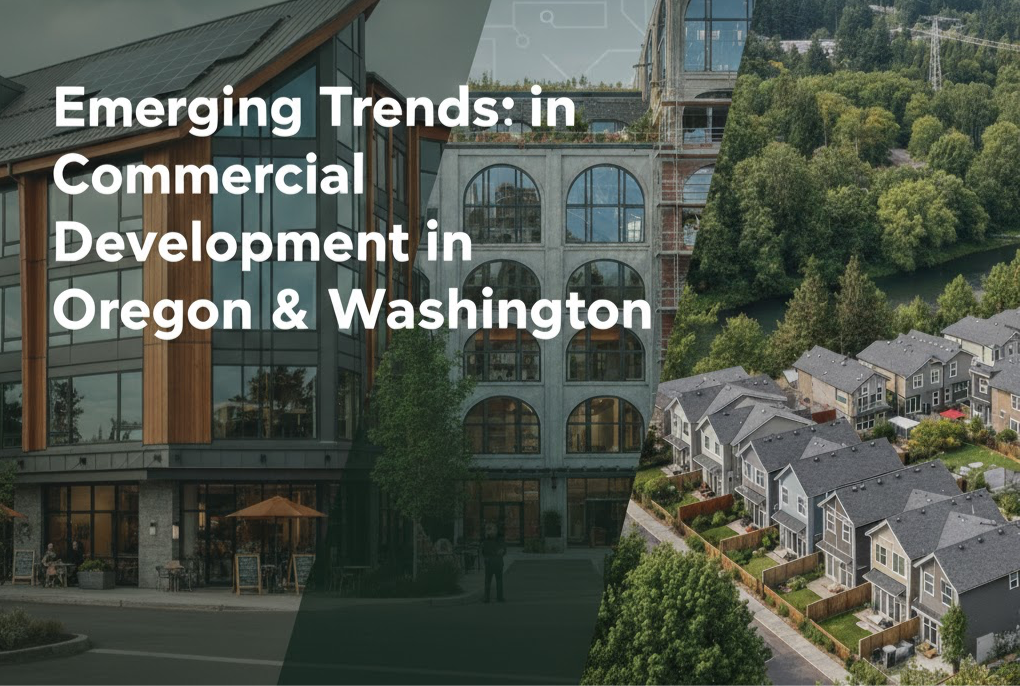
Emerging Trends in Commercial Development in Oregon & Washington
Commercial development in Oregon and Washington is shifting quickly. Policy changes, evolving market demand, and rising sustainability expectations are all reshaping what developers, investors, and planners need to consider before breaking ground.
For anyone planning a commercial project in the region, staying ahead of these shifts isn’t optional. It’s part of making sure a project pencils out and moves through approval without unnecessary delay. Here are five forces shaping commercial development across the Pacific Northwest right now, and how BC Group helps clients navigate each one.
1. Permitting Reform Is Making Zoning Rules Clearer
Washington State has been moving toward permitting and land-use reform intended to reduce ambiguity for developers. Legislation such as ESSB 5611 is aimed at clarifying permitting workloads for local governments and expanding what qualifies as commercially zoned property, including sites that conditionally allow multifamily residential use.
Note: Specifics of this legislation should be verified against the current bill text, since provisions can change during the legislative process.
There’s also momentum behind broader efforts to require development regulations that are clear and objective, which would reduce some of the guesswork currently built into permitting decisions.
For developers, the stakes here are real. Unpredictable zoning and slow approvals can add months, or more, to a project timeline. Understanding how these reforms apply to a specific site, and how they interact with local permitting practices, is worth doing early. See our related coverage of recent developments in Portland’s permitting and housing landscape for more detail.
2. Office Buildings Are Being Converted Into Something Else
Post-pandemic shifts in how people work have left a meaningful share of downtown office space underused across the region. In Portland, elevated office vacancy has made converting older office buildings into multifamily or mixed-use projects a more attractive option than it was a few years ago. In Whatcom County, Washington, similar office losses are creating openings to repurpose buildings into housing, co-working space, retail, or community uses.
Adaptive reuse does more than fill a vacant building. It can also come with tax incentives, support sustainability goals by avoiding new construction, and help close local housing gaps faster than ground-up development. For a closer look at this trend, see why adaptive reuse is gaining momentum and could unused office space help solve the lack of housing.
3. Sustainable Building Is Becoming a Competitive Advantage, Not Just a Requirement
Green building has moved well past a compliance checkbox in Oregon and Washington. Developers are increasingly finding that energy-efficient, sustainable design pays for itself. In Oregon, legislation such as House Bill 2021 has pushed electricity providers toward reducing greenhouse gas emissions, which is increasing demand for commercial buildings designed to operate more efficiently from the start.
Note: Specific requirements of House Bill 2021 should be verified against the current statute before publishing as a precise claim.
Investments in LED lighting, efficient HVAC systems, solar integration, and high-performance insulation tend to lower long-term operating costs and can come with tax incentives. They also matter to tenants: buildings designed with sustainability in mind are increasingly able to attract higher-quality tenants, some of whom are willing to pay a premium for it. For more on certification standards, see comparing LEED and WELL.
4. Multifamily and “Middle Housing” Demand Keeps Growing
Purely commercial projects still matter, but demand for mixed-use and multifamily development is climbing, especially in walkable urban and suburban areas. In Portland, multifamily properties have generally held up better on vacancy than other building classes, supported in part by younger renters who prioritize walkability, amenities, and flexibility over larger units.
At the same time, “middle housing,” meaning townhomes, duplexes, and small apartment buildings, is emerging as a way to add density without high-rise construction. Oregon’s zoning reforms have specifically opened the door to more of this housing type. Read more in Oregon’s new housing laws and middle housing reforms.
5. Growth Is Spreading Beyond the Major Metro Areas
Seattle, Portland, and the Vancouver-Clark County corridor still draw the bulk of attention, but smaller cities and rural areas are seeing outsized commercial investment.
Prineville, Oregon, has become known for its role in data-center infrastructure, which has driven significant industrial and commercial capital investment in the area. Redmond, Oregon, is seeing growth across retail, hospitality, and mixed-use development, along with office investment, despite being far smaller than Portland.
Note: These characterizations of Prineville and Redmond reflect general regional reporting and should be verified against current data before publishing as definitive claims.
For developers, looking beyond the core metros can mean lower land costs, fewer regulatory constraints, and potentially stronger margins, particularly in industrial, retail, hospitality, or mixed-use projects. See our related analysis of Oregon’s commercial construction hotspots for more.
How BC Group Helps You Navigate These Trends
BC Group works with developers, municipalities, and capital partners to act on these shifts rather than just track them. Whatever the project type, our commercial real estate development consulting team helps clients:
- Understand and apply recent zoning and permitting reforms to a specific site
- Evaluate adaptive reuse opportunities and calculate realistic ROI
- Oversee construction of green, energy-efficient facilities that meet or exceed current code
- Identify emerging commercial hotspots worth strategic investment
If you’re planning a new project in Oregon or Washington, whether commercial, mixed-use, healthcare, affordable, or multifamily, we’d welcome the chance to talk through your vision and how to navigate the current regulatory and market landscape with confidence.
Frequently Asked Questions
What are the major trends shaping commercial development in Oregon and Washington right now?
Permitting reform, office-to-residential conversions, sustainability-driven construction, rising demand for multifamily and middle housing, and growing investment in smaller regional cities are the trends currently having the biggest impact on how projects get planned and approved.
How is permitting reform actually changing the developer’s experience?
Rather than eliminating regulation, these reforms aim to make requirements more predictable, reducing the back-and-forth and timeline uncertainty that has historically added cost and delay to projects in both states.
Is adaptive reuse always cheaper than new construction?
Not always. It depends heavily on the building’s existing structure, systems, and code requirements. It’s often more cost-effective and faster to permit, but each building needs its own feasibility analysis before assuming it’s the lower-cost path.
Does investing in sustainable building design actually pay off financially?
In most cases, yes, through lower operating costs and stronger tenant demand, though the payback period varies by project type, incentive availability, and how aggressively the building is designed toward efficiency.
Should developers only be looking at major cities like Portland and Seattle?
Not necessarily. Smaller cities such as Prineville and Redmond are attracting real investment due to lower land costs and fewer regulatory constraints, which can make them worth serious consideration depending on the project type.