

Renovate, Repurpose or Build New? How Owners Can Make the Right Real Estate Decision
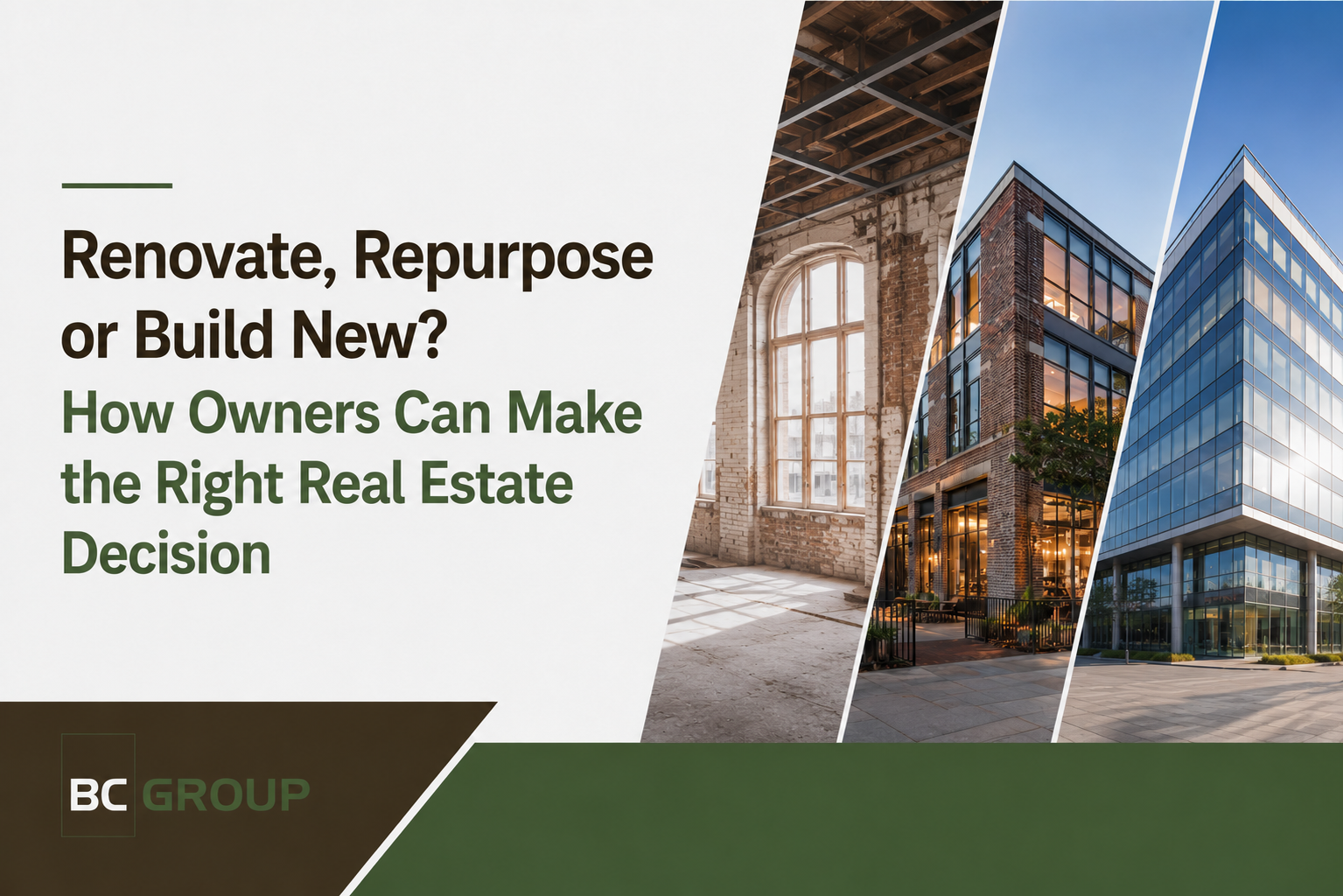
A growing company needs more room. A nonprofit has outgrown a building that worked fine ten years ago. An organization owns a property in a great location, but the space no longer fits the way people actually use it.
At that point, a deceptively simple question comes up:
What do we do with the building?
Renovate what you have? Find an existing property and repurpose it? Buy land and build something new?
There isn’t a universal right answer. And the cheapest option on the first spreadsheet isn’t necessarily the least expensive choice in the long run.
Before committing significant time and money, owners need to understand what each path really involves. That means looking beyond construction costs at the building itself, the site, schedule, operations, financing, long-term maintenance and the inevitable unknowns.
This is also where involving an experienced owner’s representative early can pay off.
Start With What You Actually Need
Before looking at buildings, floor plans or construction estimates, start with the problem you’re trying to solve.
Do you need more square footage? Better workflow? Additional parking? A different location? More housing units? Modern building systems? Room for future expansion?
It sounds obvious, but projects can get surprisingly far before those questions are fully answered.
A property becomes available in a desirable neighborhood. Someone loves an existing building. A preliminary renovation number looks attractive. Suddenly the team is trying to make its needs fit a particular solution instead of determining which solution actually makes sense.
An owner’s rep can help establish the project requirements first, then evaluate the available options against them.
That creates a much better starting point.
Renovation: Familiar Doesn’t Always Mean Simple
Staying in an existing property can be appealing.
There is no land acquisition. The organization already knows the location. Employees, customers or residents may be familiar with the building. Depending on the scope, renovation may also appear less expensive than starting from scratch.
But existing buildings come with existing conditions.
Mechanical and electrical systems may be nearing the end of their useful lives. Accessibility requirements may trigger improvements. Hazardous materials can be uncovered once walls or ceilings are opened. Structural limitations may make seemingly straightforward changes more complicated.
Then there’s one of the biggest questions: What happens while the renovation is underway?
If a building needs to remain occupied, construction may have to occur in phases. Temporary entrances, offices or facilities may be required. Contractors may have restricted working hours.
All of that affects the construction schedule and budget.
A thorough due diligence and preconstruction process helps owners understand those realities before deciding that renovation is automatically the easier option.
Repurposing: Look Beyond the Purchase Price
Adaptive reuse can create exciting opportunities, particularly when an existing property is well located but no longer suited to its original purpose.
Former offices, retail spaces, warehouses, schools and other properties can sometimes be transformed into housing, hospitality, community facilities or entirely different commercial uses.
The catch is that buildings tend to remember what they were designed to be.
An office building converted to residential use may need significant plumbing changes. A warehouse might have plenty of open space but inadequate electrical capacity. Floor plates, window placement, ceiling heights, structural grids and parking can all affect whether a new use is practical.
Zoning and code requirements matter too.
This is where the initial bargain can become expensive quickly.
Before acquiring a property for adaptive reuse, owners should understand not only whether the proposed use is allowed, but what it will take to make the building work.
Property condition assessments, feasibility studies and early involvement from architects, engineers and construction professionals can uncover issues that aren’t obvious during a property tour.
An experienced owner’s representative can coordinate that process and help translate the findings into something the owner can actually use to make a decision.
New Construction: More Control, More Decisions
There is an obvious advantage to building new: you aren’t trying to make someone else’s building fit your needs.
The facility can be designed around current operations and future plans. Building systems can be selected for efficiency. Technology can be integrated from the beginning. Sustainability goals can influence design rather than being retrofitted later.
For certain projects, that flexibility is incredibly valuable.
It comes with a different set of challenges.
Land has to be acquired and evaluated. Utilities, access, site conditions and environmental issues need to be considered. Entitlements and permitting can add months to a development schedule. Site work and infrastructure can significantly affect the budget before vertical construction even begins.
New construction also means making hundreds, eventually thousands, of decisions.
Strong development management keeps those decisions connected to the owner’s original objectives instead of allowing the project to gradually drift in cost, schedule or scope.
Compare the Whole Cost, Not Just Construction
One of the easiest ways to make the wrong decision is to compare options using incomplete numbers.
Suppose renovating an existing building is estimated at $12 million and new construction is estimated at $16 million.
Easy decision, right?
Not necessarily.
What happens if the renovation requires temporary facilities? What if major mechanical systems need replacement in five years? Does the new construction alternative require land acquisition or extensive utility work? Are there different financing implications? Could one option be completed substantially faster?
A realistic development budget can include far more than the construction contract.
Design and engineering fees, consultants, permits, testing, financing costs, insurance, furniture, fixtures, equipment, technology, relocation expenses and contingencies all matter.
So do long-term operating costs.
The better comparison isn’t simply, “Which one costs less to build?”
It’s, “What does each option really cost us?”
Don’t Ignore the Schedule
Time has value.
For a developer, a delayed opening can mean lost revenue. For an affordable housing organization, it can mean units remain unavailable longer. For a business, an inadequate facility can continue affecting employees and operations while everyone waits for the new space.
That makes scheduling part of the feasibility discussion, not something to figure out after the decision has been made.
An owner’s representative can help develop realistic preliminary schedules for renovation, adaptive reuse and new construction, including design, permitting, procurement and construction.
Sometimes the fastest option isn’t the one people initially expect.
Due Diligence Is Where Assumptions Meet Reality
Every alternative comes with assumptions.
Due diligence tests them.
What is the actual condition of the property? Can it accommodate the proposed use? Are there zoning restrictions? What will required improvements cost? What risks aren’t reflected in the asking price or preliminary construction estimate?
Spending money to answer those questions before making a major commitment can feel cautious.
It is also considerably less expensive than answering them after purchasing the wrong property.
An Owner’s Representative Helps Keep the Decision Objective
Architects, contractors, brokers, engineers and other professionals each bring important expertise to a real estate project.
An owner’s representative has a different job.
The owner’s rep looks across those disciplines and keeps the owner’s objectives at the center of the decision.
That may involve coordinating due diligence, developing preliminary budgets and schedules, evaluating development scenarios, assembling the right project team and identifying risks that need further investigation.
Sometimes that analysis confirms the original plan.
Sometimes it changes it completely.
Both outcomes are valuable.
At BC Group, our work often begins well before construction because some of the most consequential decisions in commercial real estate development happen before a project ever reaches the job site.
Renovate. Repurpose. Build new.
Each can be the right answer.