

What is an Owner’s Representative?
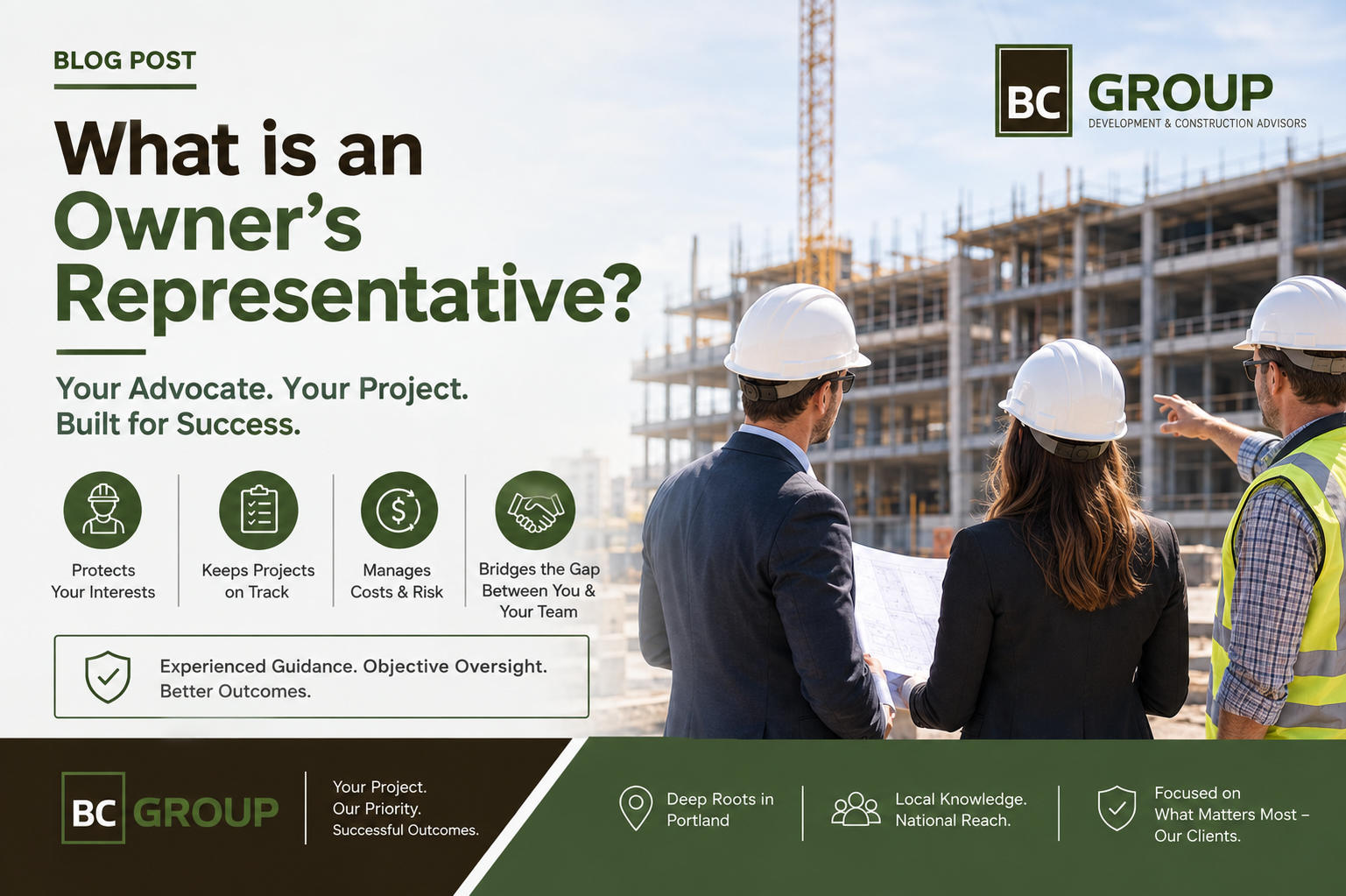
When a company decides to build a new headquarters, expand a manufacturing facility, or relocate its operations, the project almost always involves a web of architects, engineers, contractors, inspectors, attorneys, and vendors all moving simultaneously, all with competing priorities. For most organizations, navigating this complexity is far outside their core expertise.
That’s where an Owner’s Representative comes in.
In this guide, we’ll break down exactly what an Owner’s Representative is, what they do, and why engaging one can be the single most important decision you make before breaking ground.
What is an Owner’s Representative?
An Owner’s Representative, sometimes called an Owner’s Rep, Owner’s Project Manager, or OPM, is a professional or firm hired by a property owner to manage and advocate for their interests throughout a construction or real estate development project.
Think of them as your proxy expert on the ground. While the owner focuses on running their business, the Owner’s Rep focuses on running the project.
Unlike a general contractor (who builds the project) or an architect (who designs it), the Owner’s Representative works exclusively for the owner, not for the construction team, not for the design firm, and not for any vendor. This undivided loyalty is the cornerstone of the role.
Firms like BC Group and Cresa have built reputations around this principle: bringing deep construction and real estate expertise to bear entirely in service of their clients’ goals, timelines, and budgets.
The Core Responsibilities of an Owner’s Representative
Owner representation services span the full lifecycle of a project from the earliest planning conversations through final occupancy. Here’s how the role unfolds across each phase.
Pre-Construction Planning and Feasibility
Before a single permit is pulled, the Owner’s Rep helps the client understand what the project will actually require. This includes:
- Defining project scope and objectives – translating business needs into a clear, written program
- Budget development and validation – establishing realistic cost estimates before the design process begins, not after
- Site evaluation – assessing candidate locations for zoning, infrastructure, environmental, and logistical considerations
- Schedule development – building a realistic master timeline that accounts for entitlements, design milestones, and construction sequencing
This phase is where many projects go wrong, when vague intentions become firm commitments without proper due diligence. A skilled Owner’s Rep forces the right questions early, when they’re cheapest to answer.
Procurement and Team Assembly
Selecting the right architect, general contractor, and specialty subcontractors is not simply a matter of accepting the lowest bid. An Owner’s Representative manages a structured procurement process that includes:
- Preparing requests for qualifications (RFQs) and requests for proposals (RFPs)
- Evaluating candidates against objective criteria including experience, financial stability, team composition, and project approach
- Negotiating contract terms that protect the owner’s interests
- Recommending delivery methods (design-bid-build, design-build, construction management at-risk) best suited to the project’s risk profile
Real-world example: A regional healthcare system planning a new ambulatory care clinic needs a general contractor with specific experience in healthcare construction, infection control protocols, and phased occupancy. An Owner’s Rep with industry expertise can identify which firms genuinely meet that bar and structure contracts with appropriate performance guarantees.
Design Phase Oversight
During design, the Owner’s Representative acts as the owner’s voice in every meeting, every review, and every decision. Key responsibilities include:
- Design review – ensuring drawings align with the approved program, budget, and schedule
- Value engineering – identifying opportunities to reduce cost without sacrificing function or quality
- Document control – maintaining an organized record of all drawings, specifications, and correspondence
- Budget tracking – monitoring design decisions against the established budget and flagging scope creep early
This phase is critical. Every dollar of scope added during design is exponentially cheaper to remove than the same dollar added during construction. The Owner’s Rep keeps that equation visible.
Construction Oversight and Project Management
During active construction, the Owner’s Representative provides continuous construction oversight monitoring progress, quality, and cost on behalf of the owner. This involves:
- Attending regular owner-architect-contractor (OAC) meetings
- Reviewing and approving contractor pay applications
- Tracking change orders to ensure they are legitimate, fairly priced, and properly documented
- Monitoring the construction schedule and identifying delays before they compound
- Managing RFI (Request for Information) and submittal logs to ensure design intent is maintained
Real-world example: During the structural steel phase of a large commercial office build, the general contractor submits a change order claiming unforeseen subsurface conditions require additional foundation work, a $400,000 add. An experienced Owner’s Rep will independently review the geotechnical reports, consult with the structural engineer, and negotiate the change order down to its legitimate cost, which could save six figures in a single conversation.
Closeout and Occupancy
The final stretch of a construction project can sometimes be mismanaged when owners lack representation. An Owner’s Rep ensures a disciplined closeout that includes:
- Punch list management – documenting and tracking all incomplete or deficient items to resolution
- Commissioning oversight – verifying that mechanical, electrical, and plumbing systems perform as designed
- Warranty documentation – compiling a complete record of all equipment warranties, as-built drawings, and O&M manuals
- Certificate of Occupancy coordination – managing the inspections and approvals required for legal occupancy
A clean closeout protects the owner’s investment and sets up the facility for efficient long-term operations.
The Benefits of Hiring an Owner’s Representative
-
Undivided Advocacy
Every other party on a construction project including the architect, contractor, and subcontractors have their own financial interests. The Owner’s Representative has only one: yours. This single-minded focus changes how decisions get made and how disputes get resolved.
-
Expertise Without Overhead
Hiring a full-time, in-house Director of Construction with deep project management expertise could cost $150,000–$250,000 per year in salary and benefits, before you account for the team they’d need. Owner representation services provide that expertise on a project-by-project basis, scaling up or down as needed, with no long-term overhead commitment.
-
Cost Control and Savings
Studies consistently show that projects managed with professional owner representation experience significantly fewer cost overruns. The Owner’s Rep’s scrutiny of pay applications, change orders, and procurement decisions typically saves multiples of their own fee. For a $10 million construction project, even a 5% reduction in unnecessary change orders represents $500,000 returned to the owner.
-
Time Savings and Schedule Discipline
Construction delays cost money in carrying costs, lost revenue, and operational disruption. An Owner’s Rep maintains continuous schedule pressure, identifies risks early, and coordinates the dozens of parties whose work must sequence correctly. This discipline consistently delivers projects faster than unmanaged equivalents.
-
Risk Mitigation
Construction projects carry legal, financial, and operational risk. An experienced Owner’s Representative understands where those risks live in contract language, design gaps, and procurement decisions and structures the project to minimize exposure before problems arise.
-
Peace of Mind
Perhaps most importantly, the owner can focus on their business while the Owner’s Rep manages the project. Executives aren’t fielding calls from the superintendent at 7 a.m. HR teams aren’t coordinating construction access. Finance teams aren’t manually auditing pay applications. The Owner’s Rep handles it all.
When Do You Need an Owner’s Representative?
Not every project requires owner representation services, but most benefit from them. Here are the scenarios where engaging an Owner’s Rep is especially important.
You’re Building or Renovating for the First Time
If your organization has never managed a construction project of similar scale, you almost certainly need an Owner’s Rep. The learning curve is steep, the mistakes are expensive, and the contractors you hire will know you’re inexperienced.
Your Project Is Complex
Multi-tenant buildings, healthcare facilities, laboratories, data centers, and mixed-use developments involve layers of technical complexity, specialized systems, regulatory requirements, and coordination challenges that demand expert oversight.
Your Core Team Is Stretched
Even organizations with some internal real estate expertise often lack the bandwidth to manage a major construction project alongside their regular responsibilities. The Owner’s Rep fills that gap without requiring a permanent hire.
Your Project Is High-Stakes
For projects where timeline, cost, or quality failure would have significant business consequences: a new headquarters, a flagship retail location, a manufacturing, the cost of professional representation is a fraction of the risk it mitigates.
You’re in an Unfamiliar Market
If you’re developing in a city, region, or building type outside your experience, local market knowledge matters. Firms like BC Group combine technical construction expertise with deep knowledge of local regulatory environments, contractor markets, and project dynamics, thus giving clients a decisive advantage in unfamiliar territory.
Similarly, Cresa brings tenant and occupier representation expertise to real estate decisions, ensuring that construction projects align with long-term portfolio strategy and lease structures that protect the owner’s position.
Owner’s Representative vs. General Contractor: Understanding the Difference
A common source of confusion is the distinction between an Owner’s Representative and a General Contractor (GC). The difference is fundamental:
| Owner’s Representative | General Contractor | |
| Works for | The owner | Themselves (under contract to owner) |
| Primary goal | Owner’s interests | Profitable project execution |
| Scope | Full project lifecycle | Construction phase |
| Risk | Advises on owner’s risk | Carries construction risk |
| Compensation | Fee to owner | Profit margin on construction cost |
The Owner’s Rep and a General Contractor often work closely together, but they represent fundamentally different interests. Having professional representation ensures someone is always asking “is this right for the owner?” not just “is this right for the schedule?”
Conclusion: Your Project Deserves an Advocate
Construction and real estate development are among the most complex, high-stakes endeavors any organization undertakes. The design process is technical. The contracts are dense. The construction market is competitive. The risks are real.
An Owner’s Representative brings the expertise, attention, and undivided advocacy that every project deserves, protecting your budget, your schedule, and your investment from the first planning meeting through the final punch list.
Whether you’re planning a ground-up development, a major renovation, or a complex tenant buildout, firms like BC Group and Cresa have the experience to guide your project to a successful outcome as your advocate, every step of the way.
Ready to Talk About Your Project?
If you’re in the early stages of planning a construction or real estate projector you’re already in progress and believe you need more support, we encourage you to reach out for a consultation.
Contact BC Group to speak with an Owner’s Representative about your project’s specific needs, timeline, and goals.
Connect with Cresa to explore how integrated tenant representation and project management services can protect your interests from lease negotiation through construction completion.
The best time to engage an Owner’s Rep is before you need one. Reach out today.
Frequently Asked Questions
How much does an Owner’s Representative cost?
Is an Owner’s Rep the same as a project manager?
The terms are sometimes used interchangeably, but “Owner’s Representative” specifically connotes advocacy on behalf of the owner, not just project coordination. A true Owner’s Rep manages the entire project team (including the GC and architect) on the owner’s behalf.
When should I hire an Owner’s Rep?
The earlier the better. Engaging an Owner’s Representative in the pre-planning or feasibility phase before you’ve selected an architect or signed a lease captures the most value. Many critical decisions (site selection, delivery method, budget parameters) are made before construction begins.
Can an Owner’s Rep help with tenant improvement projects?
Yes. Owner representation services are valuable for projects of all sizes, from small tenant improvement buildouts to large ground-up developments. The level of engagement scales to the project’s complexity and risk.
Do I need an Owner’s Rep if I already have an internal project manager?
Sometimes. If your internal PM has deep construction expertise and bandwidth, they may be able to handle certain scopes. But for complex projects, or when your internal team lacks specific technical expertise, supplementing with a professional Owner’s Rep provides significant additional value.
What’s the difference between owner representation and construction management?
A construction manager (CM) may be hired by the owner to manage the construction process. An Owner’s Representative typically stays at the oversight level managing the CM or GC on behalf of the owner rather than directly managing construction.