

Construction Project Closeout: Why the Last 10% Can Make or Break a Successful Development
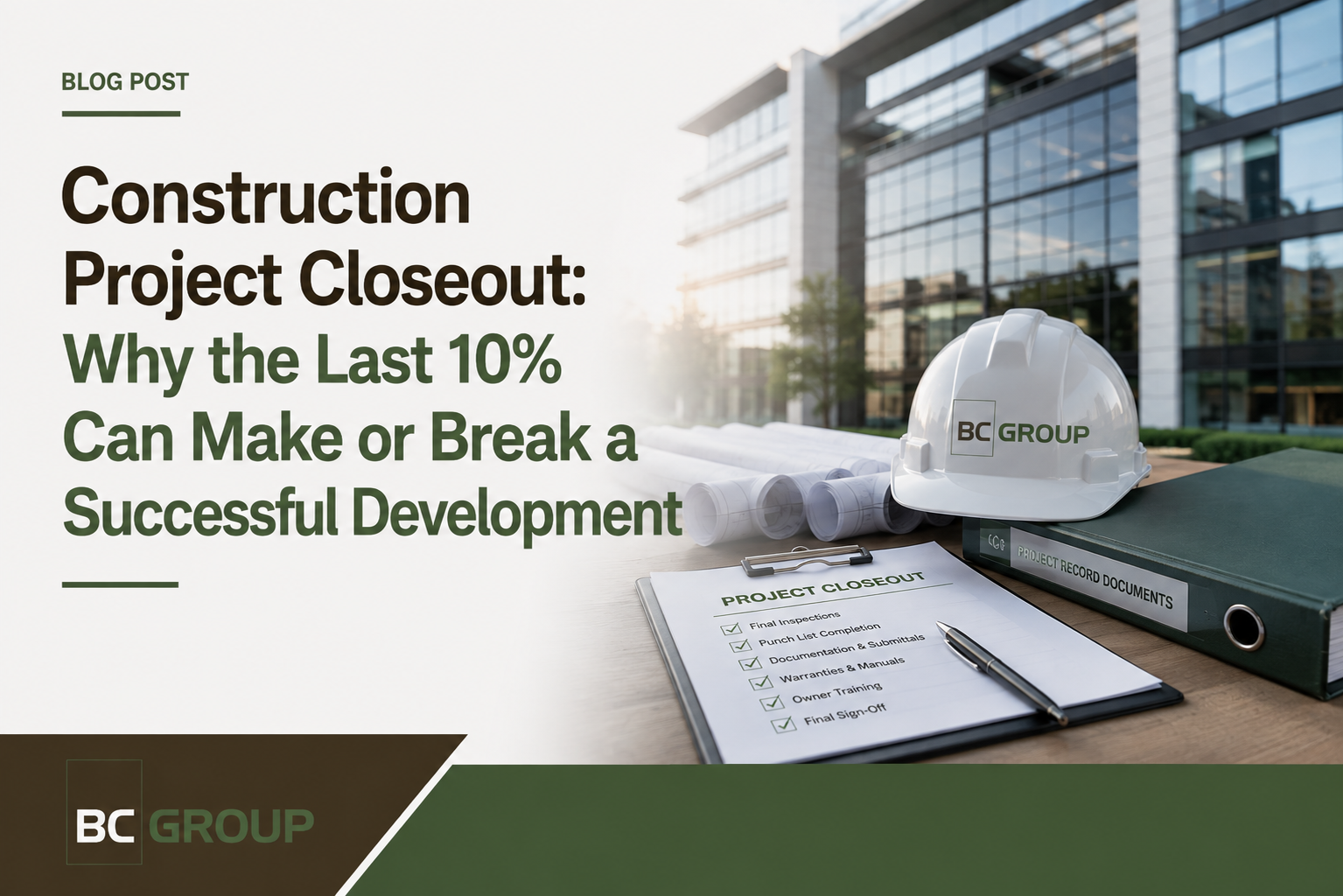
After months or years of planning and construction, the finish line is finally visible.
The building looks complete. Furniture is arriving. Employees or tenants are preparing to move in.
Everyone is ready to be done.
And that is precisely when a project can become surprisingly vulnerable.
The final phase of a construction project may represent a relatively small percentage of the physical work, but there can still be hundreds of details left to resolve. Punch-list items, inspections, permits, warranties, equipment testing, training, final payments and closeout documents all need attention.
A project is not finished simply because construction looks finished.
Why Project Closeout Gets Difficult
There is a natural loss of momentum near the end of construction.
Contractors and subcontractors may already be moving people to their next projects. The design team’s workload shifts. The owner’s staff becomes focused on occupancy and operations.
Meanwhile, the remaining items tend to be small.
A door needs adjustment. A finish needs repair. A piece of equipment needs testing. Documentation is missing.
Individually, none seems particularly serious.
Collectively, they can delay occupancy, complicate final payment and leave the owner chasing unresolved issues months after everyone else considers the job complete.
An owner’s representative helps keep responsibility and attention on the project until the work is actually done.
The Punch List Is More Than a Walkthrough
The punch list identifies incomplete, deficient or unsatisfactory work that needs correction before final completion.
A thorough process involves more than walking through the building and noting cosmetic issues.
Systems need to function correctly. Equipment needs to be installed as specified. Outstanding construction items need clear owners and deadlines.
Someone also needs to verify that the corrections actually happen.
For an owner already preparing to occupy a new facility, managing that process can quickly become overwhelming.
This is one place where continued construction management oversight provides real value.
Occupancy Is Its Own Milestone
Being physically able to enter a building and being legally and operationally ready to occupy it are not necessarily the same thing.
Final inspections must occur. Required approvals have to be obtained. Depending on the jurisdiction and project, an occupancy permit or certificate may be necessary before the facility can be used as intended.
Utilities and operational systems need to be started and tested.
These steps should not suddenly appear on a checklist during the last week of construction. A good project completion strategy anticipates them much earlier and incorporates them into the overall development schedule.
Owners Need More Than Keys
Imagine receiving a new building without the information needed to operate it.
Where are the warranties? Who services a particular piece of equipment? What maintenance does the manufacturer require? Where are the final as-built drawings?
Those questions may not seem urgent on move-in day.
Six months later, when something stops working, they become very urgent.
Project closeout should include organized transfer of warranties, guarantees, bonds, certificates, maintenance information, operating manuals and as-built documentation.
An owner’s rep can help coordinate that turnover so information does not disappear into email inboxes, contractor files or boxes no one opens again.
Training Matters
Modern buildings contain increasingly sophisticated systems.
The people responsible for operating the property need to understand them.
Training may be required for mechanical equipment, controls, security, technology, life-safety systems or other specialized components.
Those sessions should be coordinated, documented and attended by the right people.
Otherwise, an owner can inherit a technically complete building that its own team is not fully prepared to operate.
That is not a successful turnover.
Final Payments Require Careful Review
The end of a project also brings important financial decisions.
Final contractor payments, outstanding change orders, retainage and remaining invoices need to be reconciled against the work that has actually been completed.
This is not the time to lose sight of the construction budget.
An experienced owner’s representative continues reviewing costs and documentation through completion, helping the owner understand what remains outstanding before final funds are released.
The same principle applies throughout development: know what you are paying for and verify that contractual obligations have been met.
Start Planning Closeout Before the End
One of the best ways to improve project closeout is surprisingly simple.
Do not wait until the project is almost over to start thinking about it.
Closeout requirements can be discussed during preconstruction. Documentation expectations can be incorporated into contracts. Training requirements can be identified. Punch-list procedures can be established. Responsibilities for permits, testing and final inspections can be clarified.
When project management connects the beginning of the job to the end, turnover becomes a process rather than a scramble.
A Successful Project Ends With a Prepared Owner
The goal of commercial real estate development is not simply to construct a building.
It is to deliver an asset the owner can actually use.
That means the doors open when they are supposed to. Systems work. Documentation is organized. Staff knows how to operate the facility. Outstanding work is completed. Financial obligations are reconciled.
BC Group’s role as an owner’s representative extends through project completion and turnover because the owner still needs representation after the major construction work is finished.
In fact, this is one of the times when persistent oversight matters most.
After investing significant time and money into a project, the last thing an owner should inherit is a list of loose ends.
The last 10% may not produce the most dramatic construction photos.
But getting it right is what turns a completed construction project into a finished one.