

Affordable Housing Trends: How Owner’s Representatives Drive Successful Outcomes
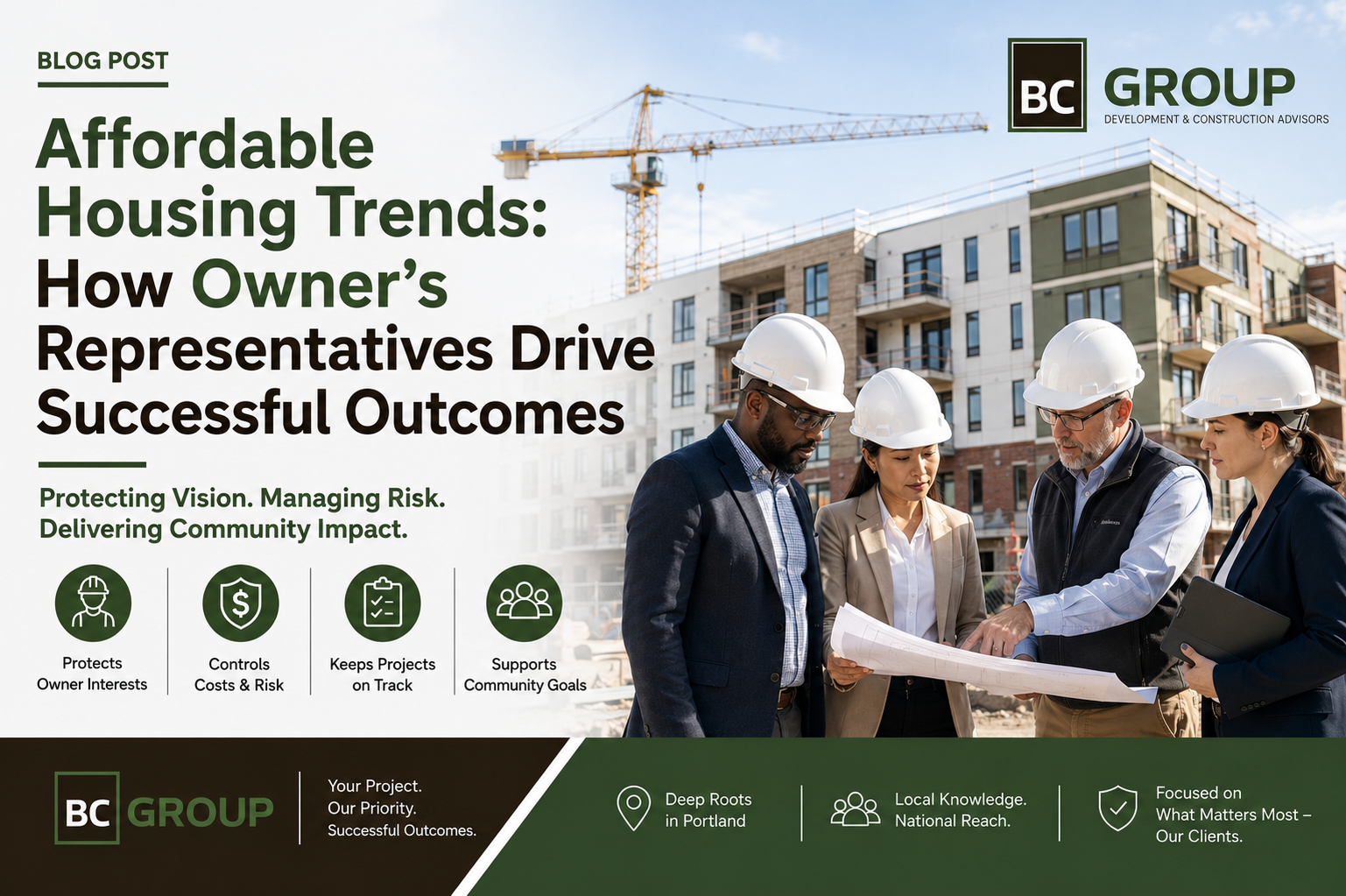
Affordable housing is a pressing issue facing communities across the country as it becomes more challenging to develop as construction costs, labor shortages, higher interest rates, zoning restrictions and other funding challenges continue to present issues for public agencies, nonprofits and private developers seeking to create financially viable housing for growing populations.
Achieving success in today’s market requires more than a good site and a capable design team. Owners need to develop affordable housing in a manner that is financially viable, and require careful planning, proactive coordination and disciplined project management from the earliest stages of development. An experienced Owner’s Representative can make a big difference in achieving successful outcomes.
At BC Group, we don’t consider the affordable housing market to be ‘new’ or an ‘emerging’ market. Instead, we view it as one of BC Group’s core specialties, where we can bring the greatest amount of value as Owner’s Representative and development advisors to owners of affordable housing projects. This is because we have a depth of experience in a wide variety of affordable housing projects, including supportive housing projects.
Affordable Housing Is Becoming More Complex
One way to think about the growing complexity of affordable housing is to realize that while market rate projects have two major stakeholders (the owner and the Architect/Design Team), affordable housing projects can easily have 10 to 15 or more major stakeholders (e.g.
A single project may include:
- Local municipalities
- State housing agencies
- Nonprofit organizations
- Community groups
- Multiple funding partners
- Architects and engineers
- General contractors
- Property management teams
Each stakeholder has their own objectives, requirements, and processes for approval. Therefore, it’s essential to continuously keep an eye on all aspects in order to keep everyone on board and stick to the schedule and budget.
A combination of different financing, tax incentives, grants and public funding programs characterize most affordable housing projects. Decisions made during the design process can have major consequences on the project’s eligibility, construction costs, operating expenses, and in the long run its financial performance overall
Affordable housing projects can definitely be delayed due to lack of experienced project management. Small issues can be blown out of proportion and cause delays and increased costs.
Zoning Has Become a Strategic Advantage
The strategy of using zoning as a way to encourage more housing in communities is rapidly becoming mainstream. In virtually every community in the country, there are now ongoing discussions regarding increased production of housing, with many communities going through the process of revising their zoning to allow greater density.
Even when there are opportunities as a result of zoning having become a strategic advantage, they have to be utilized by developers who are familiar with the relevant procedures and requirements associated with relevant projects.
An Owner’s Representative can identify zoning issues early in the project by acting as a link between the owner/developer, the architects, engineers, attorneys, and others involved in land use. Rather than waiting for problems to surface after the design is complete and significant amounts of time and money have been invested, entitlement issues can be identified and resolved before they create costly problems for the project.
Early coordination can also help prevent costly redesigns, reduce the risk of permitting delays, and establish whether a project is feasible in the first place.
We provide due diligence, entitlement, permitting, consultant management and development strategy services for owners of sites under consideration for development long before construction commences.
Maximizing Incentives Without Losing Momentum
Affordable housing developments frequently rely on the financial incentives to make the project economically possible.
These may include:
- Low Income Housing Tax Credits (LIHTC)
- Local and state housing grants
- Tax abatements
- Public infrastructure assistance
- Energy efficiency incentives
- Opportunity Zone benefits
- Community development funding
Often these financial incentives have their own ‘terms and conditions’ i.e. deadlines, reporting requirements, compliance conditions etc., which need to be documented and tracked.
In many cases, a developer may submit an application for financing, only to miss a submission date or fail to coordinate design decisions with funding requirements, thus jeopardizing the project’s financing or requiring costly redesigns.
An experienced Owner’s Representative can keep track of all of these incentives, while also coordinating designers, consultants and contractors to achieve project goals.
Instead of stalling the project with the individual requirements of the various incentive programs, they can be included in the overall project management strategy.
Delivery Strategy Matters More Than Ever
There’s no single approach that works for every affordable housing development.
Selecting the wrong delivery method can affect:
- Project schedule
- Cost certainty
- Contractor involvement
- allocation
- Change order frequency
- project quality
Factors affecting the Owner’s Representative’s decision as to the best project delivery method include project complexity, the housing project’s required financial resources, required project completion date, and Owner needs and priorities.
This is so much more than just managing the construction of a project. The Owner’s Representative can help an owner even before the contracts are signed to make informed decisions regarding the project.
The most successful projects are the ones where the right delivery method is chosen early in the process and allows for smooth construction, effective collaboration, and few surprises along the way.
Managing Risk Before It Becomes Expensive
Affordable housing projects operate within tight financial margins.
Unexpected site conditions, utility conflicts, permitting delays, material price fluctuations, or poor coordination between parties, to name a few, can quickly impact a project’s affordability.
Experienced Owner’s Representatives focus heavily on identifying risks early.
This includes:
- Comprehensive due diligence
- Design review and constructability analysis
- estimating and budget validation
- Schedule monitoring
- Value engineering
- Contract review
- Change order management
- Ongoing communication among project stakeholders
Proactive steps can be taken to identify and mitigate potential problems that could affect a project during the construction phase.
By identifying and preventing problems before they occur, owners can be confident that their affordable housing development is being delivered on time and within budget.
Communication Is Often the Biggest Success Factor
In the vast majority of cases, there are numerous organizations involved with the goal to create housing at affordable prices in order to help low income people.
Without clear communication, misunderstandings become delays.
Architects may interpret owner priorities differently than contractors.
Funding agencies require documentation which is not given by the project team.
Consultants often make decisions without fully understanding the implications on issues related to permitting or construction.
The Owner’s Representative is the main coordinator for all the parties involved, and makes sure that all the information required by each party is provided, and that all the decisions made by each party are documented in time to prevent any future problems.
By having an Owner’s Representative involved, confusion is minimized, responses are made in a timely manner, and the project is able to continue to move forward.
Experience Makes a Difference
Affordable housing requires more than construction expertise.
It requires an Owner’s Representative who is familiar with the process of public funding, community engagement, and necessary regulatory compliance for affordable housing projects.
BC Group has experience supporting the development of affordable housing projects including supportive housing and mixed-use residential projects. We provide Owner’s Representative services as well as construction management services during the design and construction phases of a project. These services include constructability reviews, value engineering, budget reporting, contract negotiations, scheduling, change order management, and quality control, among other services required to support the Owner throughout the design and construction phases of a project through to final occupancy.
Building More Than Housing
Affordable housing projects can create lasting impacts on a neighborhood and the families, seniors, veterans and individuals who will live in the developed housing.
A key indicator of a project’s success is the thoughtful planning, the disciplined management and the quality of leadership provided to the project from the development stage through to the project’s completion and occupancy.
The Owner’s Representative will coordinate and manage all parties involved in the successful completion of the project. Their primary function is to protect the Owner’s interests and ensure the project is completed on time, within budget and in accordance with the Owner’s objectives.
As affordable housing continues to evolve with new zoning, novel methods of financing, and different construction models, the need for effective management increases accordingly.