
Commercial Development in the Pacific Northwest – Healthcare Remains Strong
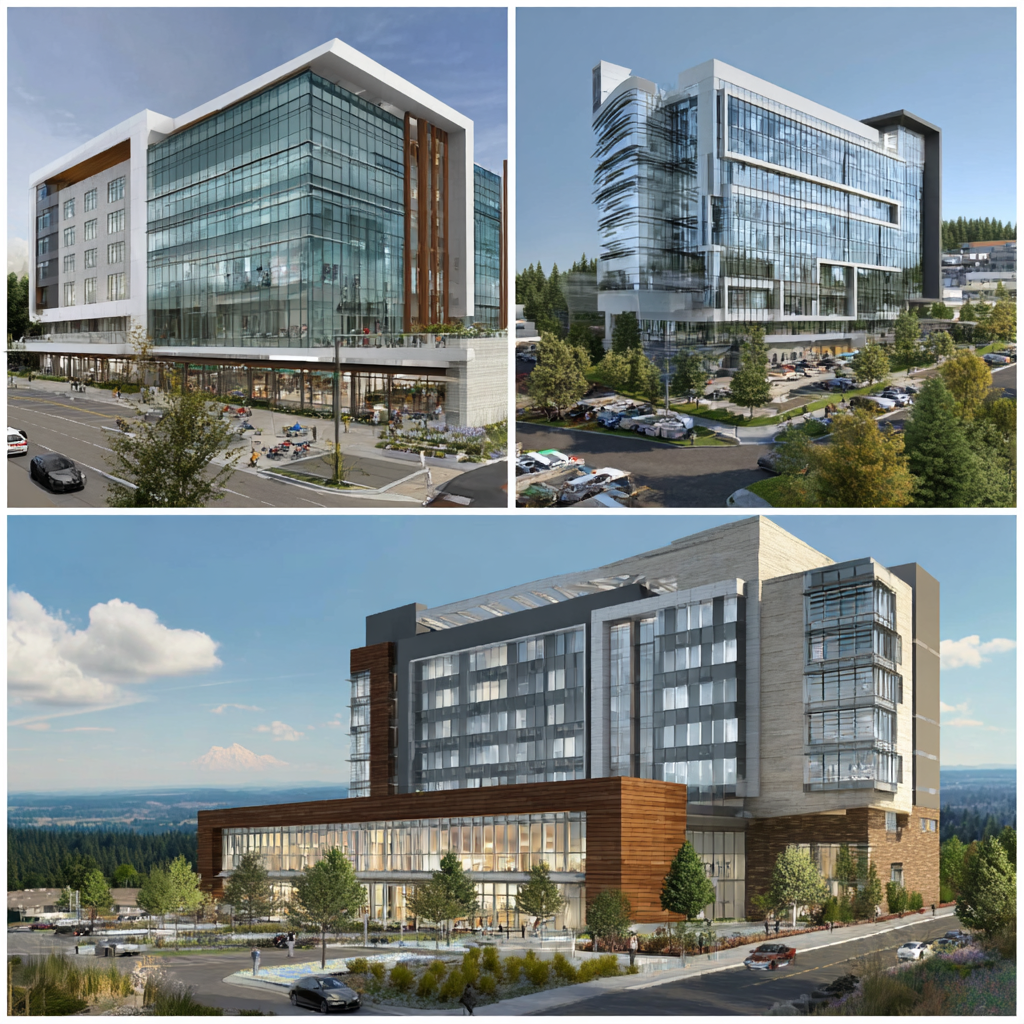 We’ve all seen that the Pacific Northwest continues to evolve rapidly, and commercial real estate development in Oregon and Washington reflects shifting economic, demographic, and industry-specific dynamics. In recent years, growth has focused less on speculative office towers and more on mixed-use, multifamily, industrial, logistics, and the focus of this article – healthcare facilities.
In Oregon, for example, the metro area around Portland, Oregon remains the region’s most active development hub as we’ve discussed before. New projects range from mixed-use office/housing districts to industrial and logistics nodes near the port. One particularly notable development is the expansion at Oregon Health & Science University (OHSU): a 14-story hospital expansion on Marquam Hill, estimated at $650 million and slated to open in 2026, underlines healthcare’s central role in the region’s current commercial pipeline.
Beyond healthcare, Portland’s commercial real estate landscape is a mix: infill redevelopment, conversions of older office buildings into multifamily or creative office, and targeted growth in industrial/logistics, especially around the port, I-5/I-205 corridors, and suburban nodes such as Beaverton and Hillsboro.
Meanwhile in Washington, metro areas near transit infrastructure (especially around the light-rail expansions in Puget Sound) are seeing a surge in multifamily and mixed-use development. According to a recent report from Colliers for Q2 2025, roughly 13,755 multifamily units are under construction in the region, boosted by transit-oriented demand and housing shortages.
Overall, the commercial real estate (CRE) picture across Oregon and Washington is one of selective strength: while traditional office construction remains under pressure, sectors like industrial/logistics, multifamily/residential, and healthcare are showing resilience or growth — shaped by population shifts, housing demand, and changing demand for services.
Healthcare Real Estate: A Cornerstone of Stability
Among the most compelling stories in recent CRE activity is the resilience and growing strategic importance of healthcare real estate, especially outpatient care and medical office buildings (MOBs). Nationally and regionally, this class of real estate is increasingly viewed as a defensive, stable asset.
In mid-2025, MOB occupancy rates have held firm around 92–93%, even as overall construction activity remains sluggish. Rental rates for MOBs remain stable and moderately rising, highlighting continued demand and underscoring that healthcare real estate remains attractive even in uncertain economic times.
As hospitals look to expand outpatient facilities and adapt to changing patterns of care like more outpatient services, more specialized care, and an aging population, demand for well-located, high-quality MOBs near hospital campuses or population centers increases.
In the Pacific Northwest, tight supply and constrained new construction, whether due to rising labor and materials costs or regulatory/local planning pressures, means existing medical facilities remain fully utilized, and new developments (like OHSU’s hospital expansion) often serve as anchors for further CRE activity.
Looking to 2026: Opportunities & Challenges
As we head into 2026, several forces converge to shape the outlook for commercial development and healthcare real estate in Oregon and Washington.
Stability and Strategic Demand in Healthcare
Because demand for healthcare is relatively inelastic as people need care regardless of economic cycles, healthcare real estate, especially outpatient and medical office, is positioned to outperform broader CRE markets. With an aging population and continuing shift toward outpatient services, MOBs will likely remain core to the region’s real estate demand, and institutional investors are expected to renew or increase interest in the class. Moreover, with limited new construction as the national MOB pipeline remains near cyclical lows in 2025, expect upward pressure on rents, stable occupancy, and perhaps more creative re-use or renovation of existing medical properties rather than new builds.
Continued Selective Growth Across CRE Sectors
In Portland and throughout Oregon, mixed-use developments, infill redevelopment, industrial/logistics expansion, and multifamily housing will remain key. Industrial and logistics sectors, especially around freight routes, ports, and suburban corridors,will stay strong due to e-commerce, supply chain demands, and regional distribution needs.
In Washington’s Puget Sound, multifamily development near transit light-rail lines will likely continue, driven by population growth, demand for housing near transit, and limited supply, although rising materials costs and interest rates may keep this growth measured.
Beyond that, expect to see more conversions: older commercial/industrial buildings redeveloped into housing or creative office, especially in central and inner-suburban neighborhoods with high demand and limited new land supply.
Challenges Ahead — Labor, Costs, Market Conditions
But 2026 won’t be without challenges. Rising construction costs and regulatory burdens continue to make new builds expensive, especially for specialized uses like healthcare. This may slow development in some sub-markets or push providers toward smaller buildouts, renovations, or adaptive reuse.
Additionally, workforce shortages in healthcare, from specialists to support staff, remain a concern, complicating expansion plans even if space is available according to a recent report from Cushman Wakefield.
Finally, economic uncertainty and evolving real estate financing conditions could slow some speculative or large-scale CRE projects, especially office-heavy ones. In that environment, property owners and developers may need to be more strategic about location, asset class, and use to maximize resilience.
What This Means for Stakeholders: Patients, Developers, Investors
- For developers & investors: Healthcare real estate, particularly outpatient/medical office, represents a relatively safe, stable long-term investment compared to traditional office space. Mixed-use, logistics, and residential near transit remain attractive.
- For healthcare providers and systems: Tight supply and high demand suggest early planning is key. Renovations, adaptive reuse, or partnerships with experienced developers may be the fastest way to expand capacity.
- For communities & policymakers: Mixed-use and transit-oriented development can help meet housing needs, support local economies, and integrate healthcare access into growing neighborhoods.
Conclusion
The commercial real estate landscape in Oregon and Washington is evolving, and in many ways, maturing. While speculative office towers are less common these days, the growth and stability in healthcare, industrial/logistics, multifamily, and mixed-use segments reflects shifting demand and broader economic trends. As we move toward 2026, healthcare real estate, especially medical office buildings and outpatient facilities, is set to play a central role in this transformation, offering both stability for investors and essential infrastructure for communities.
If you’re watching the Pacific Northwest for new commercial opportunities, especially in healthcare, now is the time to get strategic: assess evolving demand, be ready for rising costs, and think beyond traditional office or residential models.
Here’s to smart development, resilient assets, and healthier communities ahead.