

Commercial Development in the Pacific Northwest – Healthcare Remains Strong
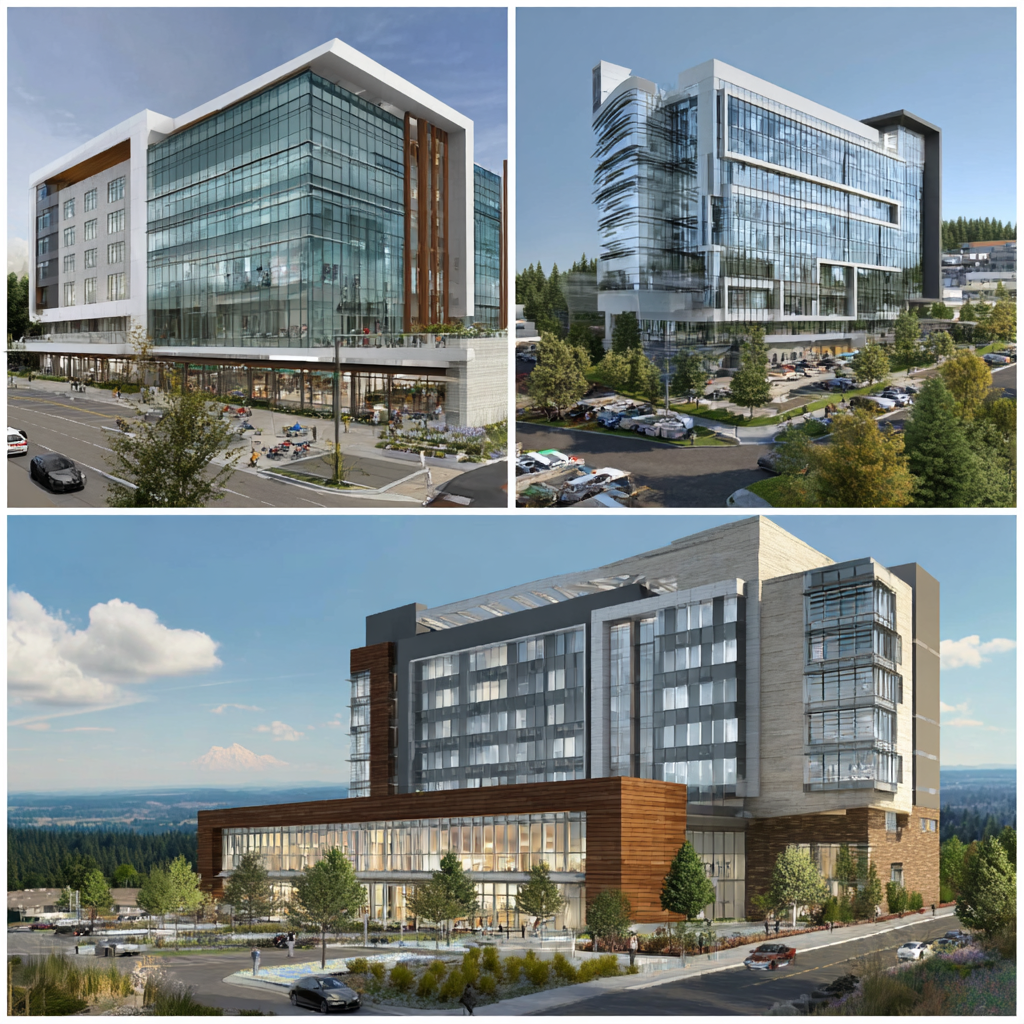
Commercial real estate development in Oregon and Washington continues to shift. In recent years, growth has moved away from speculative office towers and toward mixed-use, multifamily, industrial and logistics projects, and, increasingly, healthcare facilities.
In Oregon, the Portland metro area remains the region’s most active development hub, with projects ranging from mixed-use office and housing districts to industrial and logistics nodes near the port. One especially notable project is the expansion at Oregon Health & Science University (OHSU): a 14-story hospital addition on Marquam Hill, reportedly estimated at $650 million and slated to open in 2026.
Note: These figures should be verified against OHSU’s own public announcements before publication.
This single project underscores just how central healthcare has become to the region’s current development pipeline. Beyond healthcare, Portland’s commercial landscape remains a mix of infill redevelopment, conversions of older office buildings into multifamily or creative office space, and targeted industrial and logistics growth, particularly around the port and the I-5/I-205 corridors, as well as suburban nodes like Beaverton and Hillsboro.
In Washington, metro areas near transit infrastructure, especially around Puget Sound’s light-rail expansions, are seeing a surge in multifamily and mixed-use development. A recent Colliers report for Q2 2025 puts the number of multifamily units currently under construction in the region at roughly 13,755, driven by transit-oriented demand and ongoing housing shortages.
Note: This figure should be verified against the original Colliers report before publication.
Taken together, the picture across Oregon and Washington is one of selective strength. Traditional office construction remains under pressure, while industrial and logistics, multifamily and residential, and healthcare real estate are showing genuine resilience, shaped by population shifts, housing demand, and evolving patterns of care. For broader context, see our related piece on emerging trends in commercial development in Oregon and Washington.
Healthcare Real Estate: A Cornerstone of Stability
Among the more compelling stories in recent commercial real estate activity is the growing strategic importance of healthcare real estate, particularly outpatient care and medical office buildings (MOBs). Both nationally and regionally, this asset class is increasingly viewed as defensive and stable.
As of mid-2025, MOB occupancy rates have reportedly held firm around 92 to 93%, even as broader construction activity remains sluggish, with rental rates staying stable to moderately rising.
Note: These figures should be sourced and verified before publication.
As hospitals expand outpatient facilities and adapt to more specialized and outpatient-focused care for an aging population, demand for well-located, high-quality MOBs near hospital campuses or population centers continues to climb. In the Pacific Northwest specifically, tight supply and constrained new construction, driven by rising labor and materials costs as well as regulatory and local planning pressures, mean existing medical facilities remain fully utilized. Projects like OHSU’s hospital expansion increasingly serve as anchors for further commercial development nearby.
Looking Ahead to 2026: Opportunities and Challenges
Several forces are converging to shape the outlook for commercial development and healthcare real estate in Oregon and Washington heading into 2026.
Healthcare demand remains structurally strong. Because healthcare demand is relatively inelastic, people need care regardless of economic conditions, outpatient and medical office real estate is positioned to outperform broader commercial markets. With an aging population and continued movement toward outpatient services, institutional investor interest in this asset class is expected to hold or grow. Limited new construction nationally suggests upward pressure on rents, stable occupancy, and more renovation or adaptive reuse of existing medical properties rather than new ground-up builds.
Growth continues across other sectors, selectively. In Portland and across Oregon, mixed-use development, infill redevelopment, industrial and logistics expansion, and multifamily housing remain active. Industrial and logistics activity near freight routes, ports, and suburban corridors should stay strong, supported by e-commerce and regional distribution demand. In Washington’s Puget Sound region, multifamily development near transit will likely continue, though rising materials costs and interest rates may keep growth measured rather than rapid. Expect continued conversion of older commercial and industrial buildings into housing or creative office space, especially in central and inner-suburban neighborhoods with limited new land supply.
Real challenges remain. Rising construction costs and regulatory complexity continue to make new builds expensive, particularly for specialized uses like healthcare, which may push some providers toward smaller buildouts, renovations, or adaptive reuse instead of new construction. Workforce shortages in healthcare, spanning specialists to support staff, remain a genuine concern that can complicate expansion plans even when space is available.
Note: Any specific workforce shortage report attributed to Cushman & Wakefield should be verified against the original source.
Economic uncertainty and shifting financing conditions could also slow speculative or large-scale projects, particularly office-heavy ones, pushing developers toward more strategic, resilience-focused decisions about location and asset class. Regulatory complexity is also shaped by local policy; see recent developments in Portland’s permitting and housing landscape for more on this.
What This Means, Depending on Where You Sit
Developers and investors get a relatively clear signal here: outpatient and medical office real estate offers more downside protection than traditional office space right now, while transit-adjacent multifamily and logistics assets remain reasonably attractive bets for the next several years. Our commercial real estate development consulting team can help evaluate specific opportunities.
Healthcare providers and systems face a tighter timeline than they might expect. Given constrained supply, planning early, and seriously considering renovation, adaptive reuse, or partnering with an experienced development team, is likely to get new capacity online faster than waiting on a ground-up build.
Communities and policymakers have a genuine opportunity to align housing and healthcare access goals simultaneously, since transit-oriented, mixed-use development can support both at once rather than treating them as separate planning problems.
The Bottom Line
The commercial real estate landscape across Oregon and Washington continues to mature. Speculative office towers are less common, while healthcare, industrial and logistics, multifamily, and mixed-use segments show real resilience tied to genuine shifts in demand. Heading into 2026, healthcare real estate, particularly medical office buildings and outpatient facilities, looks set to remain a central part of that story, offering both a relatively stable asset class for investors and essential infrastructure for growing communities.
For organizations evaluating new commercial opportunities in the Pacific Northwest, especially in healthcare, the current environment rewards strategic thinking: understanding where demand is genuinely growing, planning for elevated costs, and looking past conventional office or residential models where they no longer fit.
Frequently Asked Questions
Why is healthcare real estate performing better than other commercial sectors right now?
Healthcare demand doesn’t fluctuate with the broader economy the way office or retail demand can, since people need medical care regardless of economic conditions. Combined with an aging population and a continued shift toward outpatient services, that structural demand is what’s keeping occupancy and rents for medical office buildings comparatively stable.
Is now a good time to invest in medical office buildings specifically?
The current combination of tight supply, stable occupancy, and limited new construction suggests medical office space may offer more downside protection than traditional office right now, though any specific investment decision should account for location, asset condition, and current financing terms, which vary significantly by project.
Why are developers focusing on renovation and adaptive reuse instead of new construction?
Rising construction and labor costs, combined with regulatory and permitting pressures, have made new ground-up builds more expensive and slower to bring online. Renovating or repurposing existing buildings is often faster and more cost-effective, particularly for specialized uses like healthcare.
How does the Puget Sound light-rail expansion affect commercial real estate demand?
Areas near new or expanding transit infrastructure are seeing increased multifamily and mixed-use development, since proximity to transit is a significant draw for renters and a factor developers increasingly prioritize in site selection.
What should a healthcare system consider if it needs to expand capacity soon?
Given constrained supply and rising costs for new construction, starting the planning process early and seriously evaluating renovation, adaptive reuse, or a partnership with an experienced development team is likely to get new capacity operational faster than pursuing a new build from scratch.